

Hot water freezes faster than cold water? This counterintuitive phenomenon has puzzled scientists for over 2,300 years. From Aristotle's early records to Mpemba's discovery in 1960 that hot milk freezes into ice cream more quickly, the Mpemba effect has remained controversial and its underlying mechanism remains unclear.
The freezing of water is highly random, making the Mpemba effect difficult to reproduce reliably. In contrast, the aging process of glasses involves no phase transition interference, offering an ideal model for investigating this phenomenon.
Prof. WANG Junqiang’s team at the Ningbo Institute of Materials Technology and Engineering (NIMTE) of the Chinese Academy of Sciences (CAS) has observed a novel Mpemba-like effect in the aging process of glasses. The study was published in Physical Review Letters.
Using high-precision high-rate nanocalorimetry, the team measured enthalpy relaxation in three typical glasses: metallic, polymer, and molecular glasses. They found that after high-temperature pre-annealing, a glass with an initial higher energy state aged faster than one with a lower initial energy state. This suggests that the Mpemba-like effect is universal across glasses with quite different chemical bonds.
Classical theories assume that glass aging follows a single relaxation process where a glass in a higher energy state takes longer to reach the same lower energy state. The Mpemba-like effect discovered in this work challenges this conventional view.
By analyzing the heat flow relaxation peaks, researchers found that the accelerated aging originates from the reactivation of β relaxation with a lower energy barrier during two‑step annealing. A higher β relaxation enthalpy leads to a faster aging rate, demonstrating that β relaxation plays a pivotal role in glass equilibration.
Interestingly, the Mpemba-like effect and the well-known Kovacs memory effect in glass both involve two-step annealing, but with opposite temperature sequences. This reveals a "non-commutative" property of annealing temperatures and highlights the complex interactions between different relaxation modes.
The study offers new insights for controlling glass energy and optimizing thermal treatment and relaxation processes.
This work was supported by the National Natural Science Foundation of China (Nos. 52525105, 52271158, U25A20216, U24A2039), National Key R&D Program of China (No. 2024YFB3813702), the Youth Science and Technology Innovation Leading Talent Project of Ningbo (No. 2024QL001), and the Ningbo Major Research and Development Plan Project (No. 2024Z075).
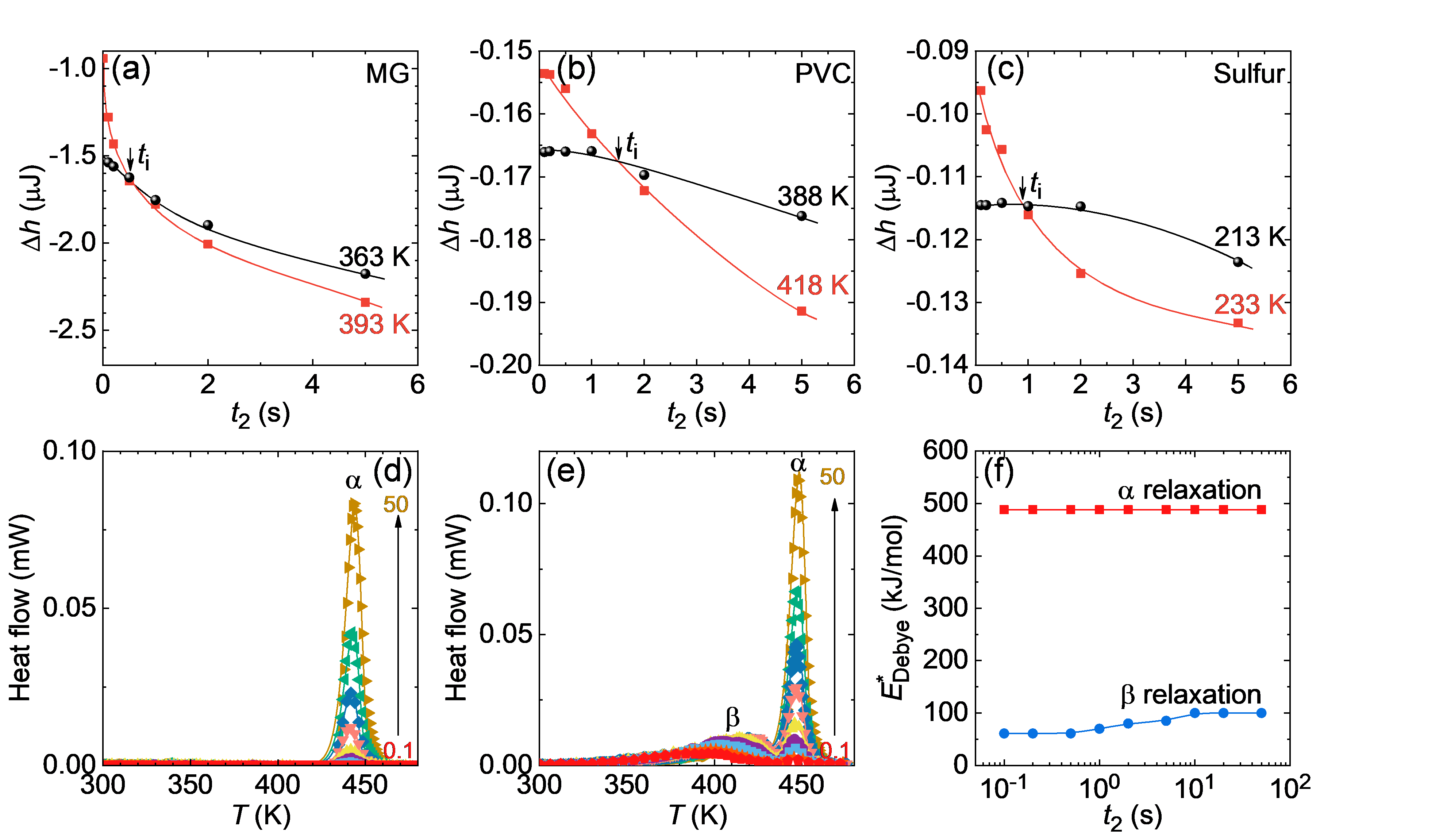
The enthalpy relaxation processes of glasses (Image by NIMTE)